The following is an updated version of an article I wrote last year, which can be found on my substack.
Before we start, a bit of context of me, I’m a white American dude with no family ties outside of America. Before starting this journey, I had little knowledge of the immigration system.
This is our story of everything we learned during the journey, step by step, and explained in a way to help educate others what the process is like. To start your own journey, I highly recommend www.visajourney.com
K1 Visa
Back in 2022, I was single and on various dating apps. One day, someone liked one of my photos on Boo Dating. So I checked her profile and she was from Malaysia. I already had an online friend from Malaysia, so I knew a little bit about the country, so I message her. We talked and soon started dating. 2 months later I bought plane tickets, and 2 months after that, I was in Malaysia.
A few months later in July 2023, me and Ida get engaged and start the immigration process by preparing to apply for the k1 and k2 visa. The k1 visa is the fiance visa. Its the visa popularized in mainstream media by the show “90 day fiance”. The k2 visa is for children of the k1 beneficiary.
I’ll be using the terms “beneficiary” and “sponsor”, as these are the terms the USCIS (United States Citizenship and Immigration Services) uses. Beneficiary in this context refers to the immigrant, and sponsor refers to the American citizen.
The k1/k2 visa form is officially called i-129f. It (at the time) cost us $535 to file the form. The form is 13 pages long and must include passport-style 2×2 inch photos, along with proof of having met in person and proof of relationship. This all has to be printed out and physically sent through the mail.

This is where the “outdated systems” part really comes to play. Why is USCIS unable to process digital applications? Every single document in the packet is a copy or printout. I can pay my taxes online, but I can’t fill out a form online? Sending by mail costs more money, takes more time, and can get lost in transit. You may think this is a minor complaint, but this will not be the only form that has to be sent by mail.
After we sent the packet to USCIS, we waited. We waited for months. What happened was that during covid, travel was restricted, and this (speculation on my part) caused current couples to delay their applications and encouraged more single people to date online (since there was less in person socializing). Whatever the true reason, after covid, there was a HUGE backlog of k1 applications between ~2021 and ~2023. What used to take just ~80 days to process was now taking over 400 days to process.
During this wait, we wanted to see each other again. We wanted her to come to America to visit, but there was an issue. An American can just get a passport, buy a plane ticket, and visit Malaysia, but for Malaysians visiting America, its different. Malaysians must apply for a tourist visa. Compared to citizens in some countries like China or Mexico, its relatively quick and easy for a Malaysian to get a tourist visa to America, but its not guaranteed. A Malaysian friend of mine wanted to visit her boyfriend in America, so she applied for the tourist visa. She paid a $185 fee, waited ~2 weeks for the interview, drove an hour to the embassy for the interview… and she was denied. If you mention you are wanting a tourist visa to visit a loved one, you’ll almost always been denied. They view you as a high risk of overstaying your visa unless you can prove very strong connection to your home country.
Because of this, we felt that the tourist visa to America wasn’t likely, and we didn’t want to waste $185 trying to apply for the tourist visa.
So in early 2024, I took another trip to Malaysia, but this time with my parents so my family could meet her family.

While in Malaysia, we checked the status of the application and it finished processing! It took 211 days. The next step was for the government to send the documents to the embassy in Malaysia and receive instructions from the embassy regarding the next steps and setting up an interview date.
We thought we were getting close to receiving the visa, but we weren’t. We weren’t even half way there yet.
Once the embassy in Malaysia received the packet (This took several weeks, as it was sent by mail from the US government), we were emailed a checklist of tasks needed to be completed before we could schedule the interview. The tasks included; completing DS-160 forms (2x since she and her daughter are both applying), completing I-134 (Declaration of Financial Support), obtain certified translations of birth certificates, evidence of relationship/engagement, obtaining a medical exam/report, obtaining a police record of good conduct, and to compile all of this into a single envelope (physical) and pdf (digital).
The DS-160 form is completely online. The US government DOES have the technology to process immigration forms online! Why every single other form requires physical printouts, but this form doesn’t, remains a mystery to me.
But this isn’t a modern website. This is like going from the pre-computer days to 1999 because the website is both old and barely functional. The website renders at 4:3 and we often ran into issues trying to submit the forms. DS-160 is a LONG form, taking over an hour to fill out. It took us closer to 2 hours per form (remember we had to fill it out twice) because of all the technical issues. You’d think a simple text web form would be a solved problem, but I guess the US government is still figuring it out.

The i-134 is a form I have to fill out that is essentially me promising to financially support the beneficiary so that she does not become a “public charge”. Lets diverge for a moment to discuss what it means to be a “public charge”.
I don’t really know.
What, exactly, constitutes someone being a “public charge” isn’t entirely clear. Its clear they are not eligible for welfare programs such as SNAP, but it doesn’t mean they are ineligible for any government program. For example, her daughter can not only attend public school, but can also receive free meals at school. Which government programs they can and can’t take advantage of varies from program to program, and its often not clearly define. Often, a program will say “available to some non-citizens with certain valid visas” without actually detailing which visa is acceptable.
So back to the actual form.
I was required to provide both a digital and physical copy of the entire packet. The packet included the form itself (13 pages), along with evidence of income. I was required to supply an entire year of bank statements, proof of employment, my latest tax return, and records of my other liquid assets (mostly stocks). This ended up being around 60 pages of documents.
This form is only valid between now and until we get married. After we get married, we have to fill out a different, but very similar form promising financial support. So that means printing and compiling all the same documents for a 2nd time. The only substantive difference between form i-134 and i-864 is that the first one required I show I have 100% above poverty income for everyone in the household (3), and the second form requires I show I have 125% above the poverty income.
The birth certificate translation, evidence of relationship, and record of good conduct, were trivial. It took some time and money, but nothing much of note. It was around $20 total.
Obtaining a medical exam/report was not trivial. There were so many complications at this step that it is genuinely hard to follow.
For someone healthy on no prescriptions, this step is quick and simple. What they’d needed is their medical records, required vaccines, and to get a physical. But for Ida and her daughter, they needed a medical report that explains their needs for prescriptions while also demonstrating that they are in stable conditions. Anyone on anti-depressants or a history of self harm has a risk of being denied the visa at this stage. Part of the purpose of the medical report is to demonstrate that the beneficiary is not a harm to herself or others around her. Others HAVE been denied at this stage.
For Ida, she had been diagnosed with depression and went to a few sessions of therapy. She had a history of self harm in her teenage years, but nothing recent. We thought it wouldn’t be serious enough to deny her visa, but we couldn’t be sure.
Over the next month, she collects her medical records and schedules the appointments she needs. She talks to the hospital and they tell her it will be up to 30 working days until the medical report is completed. Waiting an additional 30 working days is more than we hoped, but we wait. ~35 days later (~30 business days), she gets a call from the hospital and they tell her its ready. She picks up the report. She then takes it to the clinic that the embassy specifies she must go to to complete the medical exam, but the clinic looks at the medical report and tells her it wasn’t filled out correctly. A doctor wrote the report, when it was suppose to be a specialist who should write the report. We were flabbergasted. It was extremely painful to learn that, due to a mistake by the hospital, we would have to wait another 30+ days apart.
Ida goes back to the hospital to request the proper medical report from the specialist. The first report was RM40, but this report is RM80 (~$20). They again tell us it will take ~30 working days until the report is finished.
Due to the multiple holidays and the specialist getting sick, it took a full 2 months for the report to be completed. Once she picked up her report, she was able to schedule a medical exam for the following week. It cost a combined ~$380 for both of their medical exams. After that was all complete, we were able to reply to the email from the embassy with all the requested documents.
From the date the i-129f form was processed (referred to as “Notice of Action 2” or NOA2), to the date that we gathered all the documents to send to the embassy is 8 months. It is now November of 2024.
The interview can now be scheduled. We spend a few hours navigating the website to schedule the interview. There are multiple different pages to navigate through. She has to create an account and fill out several pages of forms. Some pages are confusing, such as when it asks for “immigration type”.
K1 is a weird visa that is both an immigrant visa AND a non-immigrant visa. Sometimes, when navigating government websites or forms, you must input the k1 visa as a non-immigrant visa. Other times, its categorized as an immigrant visa. It is officially a non-immigrant visa. But it is typically listed under immigrant visas. So whether the US government categorizes it as an immigrant or non-immigrant visa just depends on the mood of the government worker that day, I guess.
Once that is figured out, we can select the date. The next earliest available date is around 3 weeks away, in December. We pick the date and pay the fees. The fee is $265 per person, which is $530 for both Ida and her daughter.
Its December 3rd, day of the interview. They arrive to the embassy and wait for several hours until it is their turn to be interviewed. She brings a packet of documents requested by the embassy (its all documents they have already been sent, but they asked for physical copies too) to the interview. Its a short and quick interview. They ask her a few questions, and she is approved! She doesn’t receive her visa right away, she has to wait about a week to pick up the visa at a different office.
The time between submitting the first application and receiving the visa was 498 days.
With the visa in hand, we can book the flight. The flight is booked for December 24th and costs a total of $2,041 (~$1,150 for adult ticket, ~$850 for child ticket). The flight, including layovers, is over 26 hours long.
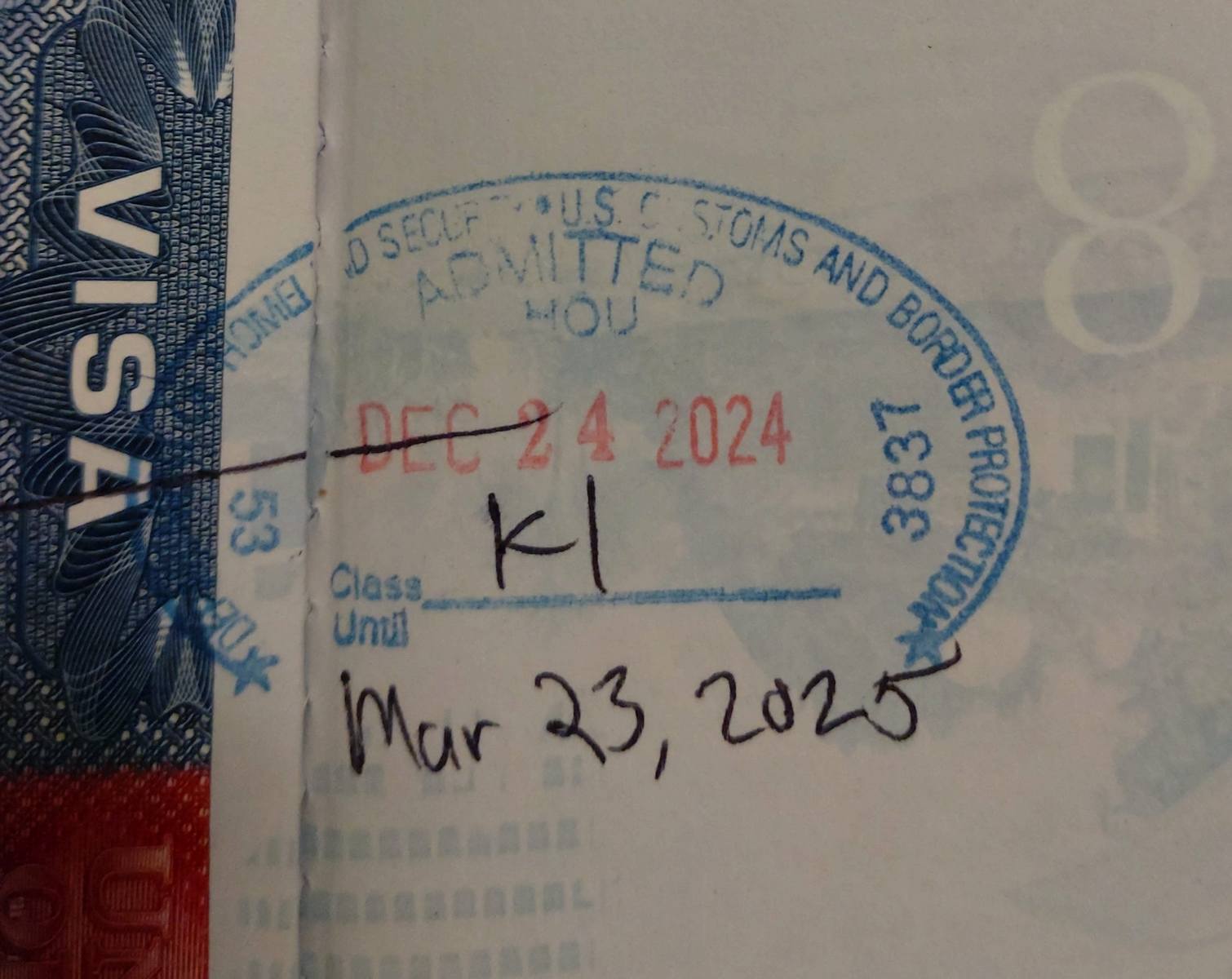
The first layover in America is in Houston, TX, which is considered her port of entry. This is where she officially enters the US and goes through immigration to get her passport stamped with the K1 visa. After a short, but mildly aggressive interview, the immigration officer stamps her passport with the k1 visa and reiterates that she must get married within 90 days.

After that, they get back onto the plane and land in Huntsville, Alabama on the night of December 24th.
90 days to get married
The first thing it was recommended that we do according to the guide we were following was to wait a week and then apply for a social security number. We want to do this before getting married since it will make things simpler. Its complicated to explain why, but some people can run into issues getting a social security number after marriage due to the name change and other reasons. So, doing what was suggested, we went to the local office and applied for a SSN. It was free.
They told us it would take 2 to 4 weeks, but the weeks go by and no updates. We call back, both the local office and national office, and they tell us the Department of Defense is processing our application, and it could take 6 weeks or so. 6 weeks go by and we call back and its the same thing. Its now over 8 weeks and we get no new answers when calling back.
We are also running out of time with the visa expiring soon. With just one week until the visa expires, we can’t wait any longer and we decide to get married. We get married at the library (they charge only $1 to certify the paperwork), and had the documents recorded at the courthouse the next day. We had 5 additional certified copies of the marriage certificate made for future use. This cost an extra $10.

Applying for Adjustment of Status (Green Card)
Its now March 2025. We have a lot of forms we have to submit. We already started working on the forms earlier, but now its time to finish them and submit them asap. There is an issue though, something I overlooked and didn’t realized until after we got married. Their visas were the k1 and k2 visas, but once they got married, their visas ended, since the purpose of the visa is just to get married. I knew and understood that part. What I didn’t fully understand is what their immigration status immediately after that was. It turns out… they don’t have one.
After people on the k1 visa get married, they are officially considered “out of status”. This means they officially have no protections and could be deported at any moment for any reason.
This bears repeating. My wife and step daughter, who we collective spent thousands of dollars on travel and immigration fees to immigrate here legally, is temporarily left with no immigration status and no protection from deportation. Even after we submit the green card application, she will still be considered out of status, but will be considered in a state of “authorized stay”. Essentially what it means is she is in immigration purgatory. Neither of legal status, nor required to leave. Authorized to stay only while the green card application is pending.
But we haven’t submitted the application yet.
Having realized how urgent it is we submit the application asap, we rush to finish filling out the forms and printing all the required documents. Again, this ALL has to be printed out and physically sent through the mail to USCIS. This is especially problematic as each day the application is moving through the mail system is another day they are here with questionable legal status. A single interaction with a police officer for any reason, including being the passenger during a traffic stop, can result us being forcibly separated.
We finish filling out all the forms, gathered all the supporting documents we need, and go to the library to get everything printed. It totaled over 100 pages, costing us around $17 to print.

We put it in a package and rushed to ship it out. We paid $12 for priority shipping.
The forms we submitted were:
Two i-485, Application to Register Permanent Residence or Adjust Status, which cost $1,400 for the first one and $950 for the second one (for her daughter);
Two i-693, Report of Immigration Medical Examination and Vaccination Record, which cost nothing;
One i-765, Application For Employment Authorization, which cost $260;
One i-864, Affidavit of Support, which cost nothing;
Three g-1450, Authorization for Credit Card Transactions, which cost nothing.
That puts the total fees for these applications at $2,650.
With this all complete, we just wait. We expect the next step to be for them to have their biometrics taken, work authorization approved, and then later the green card approved (after an interview). That is what is suppose to happen.
REQUEST FOR INITIAL EVIDENCE
On May 3rd 2025, we receive a “REQUEST FOR INITIAL EVIDENCE” (RFE) letter from USCIS. It states “The petitioner on Form i-129F and the K-1 applicant did not marry within 90 days of the K-1’s arrival into the United States; therefore, i-129F cannot be used as a basis for adjustment of status.”

What?
We DID get married within 90 days! We submitted certified copies of the marriage certificate with the dates! How frustrating that USCIS is delaying our case because of a mistake they made. The only mistake that we made that we could find after talking to some people about it is that on page 5, item 2, of form i-485, we didn’t include the receipt number in the box. BUT, we DID include the actual receipt. What is the receipt number? Great question! Its probably why we didn’t put anything since we didn’t know. Turns out its the number related to the letter we received stating that the k1 visa was approved. But we included a copy of the k1 acceptance letter, so they had that number if that was the issue. We don’t know for certain why USCIS thinks we didn’t get married within 90 days, but we gathered and resubmitted evidence of our marriage within 90 days. We included the certified marriage certificate, page 5 with item 2 filled in, and signed statements that we married within 90 days.
We paid around $1 printing documents at the library and $7 to ship the package.
The letter wasn’t a denial, so simply responding to the letter should be enough, but the application is paused until they receive and process our response. This, again, puts my wife and step daughter in jeopardy to possibly being deported at whim for any reason, despite doing everything legal and right.
For now, all we can do is wait.
Biometrics
The same week as receiving the RFE, we get a letter informing us that their biometrics appointment is scheduled for 8am in Birmingham, AL. This is around a 1.5 hour drive, so we don’t love that its so early, but its not the end of the world. The appointment should be quick, all they need to do is take fingerprints and photos.
We get there at around 7:50am and wait in line. It went mostly smooth for us, but other people had problems. For some reason, you have to bring the letter with your appointment information on it. I guess the USCIS office doesn’t have their information on file, or it has to be brought in verify their appointment? But one odd thing I overheard was that they scheduled their appointment online. So for some reason, my family was assigned a date and time, but some people (presumably people who have different visas) can set an appointment online and choose their date and time? It doesn’t make sense to me why some people can choose their appointment while others can’t. To me, it just looks like more disorganization.
A few days later, we check our status online (we can do that at certain points in the process) and see the RFE was received and our case updated. Then a day or two after that we see their biometrics were added to their cases.
Case is ready to be scheduled for an interview

Near the end of May, the status updates to say the case is ready to be schedule for an interview! Exciting! The interview is effectively the final step. Now we just wait until the interview is actually scheduled. Once its scheduled, the status page online will update and we will receive a letter in the mail with the interview date and time.
All that needs to happen is for USCIS to schedule our interview, that shouldn’t take long, right?
Every day in June, I check the USCIS website to see if it updated, but it hasn’t. Then July, August, September…. October….. Its been nearly 6 months, and the interview has STILL not been scheduled! What could be taking so long?!?!
During that same time, her work authorization was never processed. Work authorizations typically take around 2 or 3 months to be processed, but for her case, its taking over 6 months and no updates!
Interview scheduled
In November, 8 months after applying for a green card, her interview was finally scheduled…. and then promptly canceled.
We got a letter saying “due to unforeseen circumstances we had to cancel your interview”. No detailed explanation or anything. It was going to be rescheduled, but it was just another delay.
In December, almost exactly 30 days later, we get an update saying the interview was scheduled. The interview would be in January. This will be 13 months after my family entered the US on the k1 visa.
Preparing for the interview
The letter we received informing us of the interview included a very long checklist of documented we needed to bring.

None of this was too difficult or costly to compile, but it took hours to gather, copy, print, and organize everything. They wanted us to brings effectively everything, and to bring both copies and originals. We also had to bring evidence of our relationship. This includes things such as photos, marriage license, and evidence of joint assets.
Its now January and its the day of the interview. The USCIS office is in Montgomery, which is a 3 hour drive. Round trip cost us roughly $50 in gas. Luckily the interview wasn’t too early in the morning this time, so we didn’t have to wake up too early.
Interview
Its time to go to the interview. We go through security, wait around 5 minutes, and then get called to start the interview.
The interview starts by being asked to raise our hand and swear we will tell the truth. Then the interviewer goes through the paperwork and asks questions such as “Is your name…”, “Do you still live at….” while flipping through the pages. He then asks for a page to be signed. After that, he asks “do you have any questions”? “No”. “Well, you are approved. I just have to finish processing the paperwork on the computer and you’ll receive your green card in the mail within 3 weeks.”
Well… that was easy…… and a waste of time? We both felt more relieved than excited. It was great it is finally over with.. but why did we have to wait 8 months (between May 2025 and January 2026) to show up to an interview when it clearly wasn’t necessary?? We weren’t asked any questions other than to confirm some information, and none of the documents I was “required” to bring were even looked at.
Don’t take it the wrong way, we’re glad we weren’t harassed, but the interview could have just been waived, saving us time and money, and allowing my wife to start working 8 months ago. Its bittersweet. We’re thankful the interview went so smoothly, but wish we didn’t have to wait 8 months for it to take place.
On February 4th, 2026, our case was officially approved, with the green cards shipping to us. Finally completing to process. We’re so excited! We can finally rest easier knowing they now have stronger legal protections and can’t be deported and forcibly separated from each other at whim.

Total costs and time
From the start of submitting the first application, July 24th 2023, to having the green card approved, on February 4th 2026, it took 926 days.
Total costs of all the required forms and fee: $4,095
Total cost of all expenses, including flight tickets, shipping, gas, and printing: $6,234
Thats a total of 926 days and $6,234 for my wife and daughter to immigrate to the US from k1 visa to permanent resident/green card holder.
Not included is the number of hours spent researching and filling out forms. We never paid or even contacted a lawyer. We did all the research ourselves to save money. Its nearly impossible to estimate how many hours we spent on this, but it was easily 50 to 100 hours.
Next steps
The green card is conditional. It lasts for 2 years and requires that we stay married and prove our relationship status. 3 months before it expires, we must fill out another form to extend the green card to 10 years.
In March 2028, 3 years after being married, they can apply for citizenship. Also requiring a 3 year marriage period, I can legally adopt my step daughter.
Bonus: Why immigrate to the US and other thoughts
Before we started the immigration process, we thought long and hard about who should immigrate. I LOVED my visits to Malaysia. I don’t think it can be emphasized enough how much I loved staying in Kuala Lumpur (a 1 week stay and a 2 week stay). I would move there in a heartbeat if not for a few problems.

Malaysia is a Muslim country, in which muslims must follow Shariah law. Under Shariah law, muslim women can not marry non-muslims. Another thing about Malaysia, religion is not just a self identification, its a legal identification. Its not like in the US where you can just declare to be any religion you want or declare you leave the religion at any time. The process to leaving islam is much like the process of changing your legal name. And while Malaysia is more “progressive” than other muslim countries in that women aren’t required to wear a hijab and are allowed to vote, its still very socially dangerous to leave Islam.
So for me to move to Malaysia, I would either have to convert to islam, she would have to leave islam, or we just couldn’t get married at all. None of those options were good.
In addition to complications with marriage, other laws worried us, such as Malaysia’s extremely strict anti-lgbt laws. Simply selling rainbow watches will result in your business being raided by the government.
While its hard for most people in the US to believe, Alabama is a progressive utopia compared to many other parts of the world. Its because of the stronger rights and equality we have in the US, and yes, even Alabama, that we decided its better we live here rather than I move to Malaysia.
I wrote this article to help educate people on what the legal immigration process looks like in America by sharing my family’s journey. This journey has emboldened my desire for immigration reform. Immigration is almost entirely a bureaucratic process. Families should not be forcibly separated because of paperwork.
I am running for Huntsville city council district 4. It is my goal to do anything I can to support and protect immigrant families in our community. If you would like to support my campaign, please consider donating.